
Washington City Directory Collections
The best documented local route is Citizens Library's Dorothea & Henry Hood local-history center. Its holdings identify POLK and WASHINGTON City Directories from 1899 to the present, with some missing years. That coverage is useful because each edition fixes a name and address in one particular year. It is not proof that a person remained there before or after that edition. The accompanying collections below help fill a date gap or test an address, but they serve different purposes from a directory listing.
| Collection | Years | Where Held | Access |
|---|---|---|---|
| POLK and WASHINGTON City Directories | 1899-present, with gaps | Citizens Library, Dorothea & Henry Hood Center | Appointment and in-house use; date-specific staff search is available |
| Washington Reporter | Aug. 1808-Apr. 1967 | Citizens Library | In-house or eligible history-search route |
| Washington Observer | Jan. 1872-Dec. 1969 | Citizens Library | In-house or eligible history-search route |
| Observer-Reporter | Jan. 1970-Feb. 2018 | Citizens Library | In-house or eligible history-search route |
| Washington Sanborn map | Nov. 1891, eight sheets | Library of Congress | Online image gallery |
Begin with the edition closest to a known date. If that volume is absent, write down the gap rather than assuming that a missing name means the person left Washington. The library says some directory years are missing, and the public source does not offer a digitized browse run.
Washington City Directory Access
Citizens Library's genealogy information directs researchers to call 724-222-2400 or email citlib@citlib.org to arrange use of the local-history center at 55 South College Street. This is the direct route for inspecting an actual volume, its title page, its abbreviation key, and any street or reverse section that may be present. Microfilm stays in the library, although users may save material to a personal flash drive or send it by email. In-house Ancestry Library Edition is another library-only research channel.
For a focused remote request, the library's history-search service asks for complete dates and offers a $15 prepaid search by mail, online, or telephone card payment. It does not guarantee a result. That limit matters when a search turns up nothing: it can mean the requested date or name did not produce a result, not that the historical person or address never existed. Ask for a specific directory year, an article date, or an obituary date instead of a broad open-ended search.
Note: The collection's public description confirms holdings, but not a reverse or criss-cross section in every annual volume.
Washington City Records Requests
Directory research sometimes leads to a permit, city record, or older City Hall address. The City of Washington is a separate municipal government, so a City Clerk request is different from a county deed search. City Hall is at 55 West Maiden Street, and the City Clerk, Michelle R. Sperl, is the Right-to-Know Open Records Officer. The city publishes a 724-223-4200, option 1 extension 6 contact route, as well as fax and email channels. A narrow written request by address, date range, permit number, or ordinance/file number gives the city the best chance to locate a responsive record.
The City of Washington services page is the official starting point for municipal services and records-request channels.
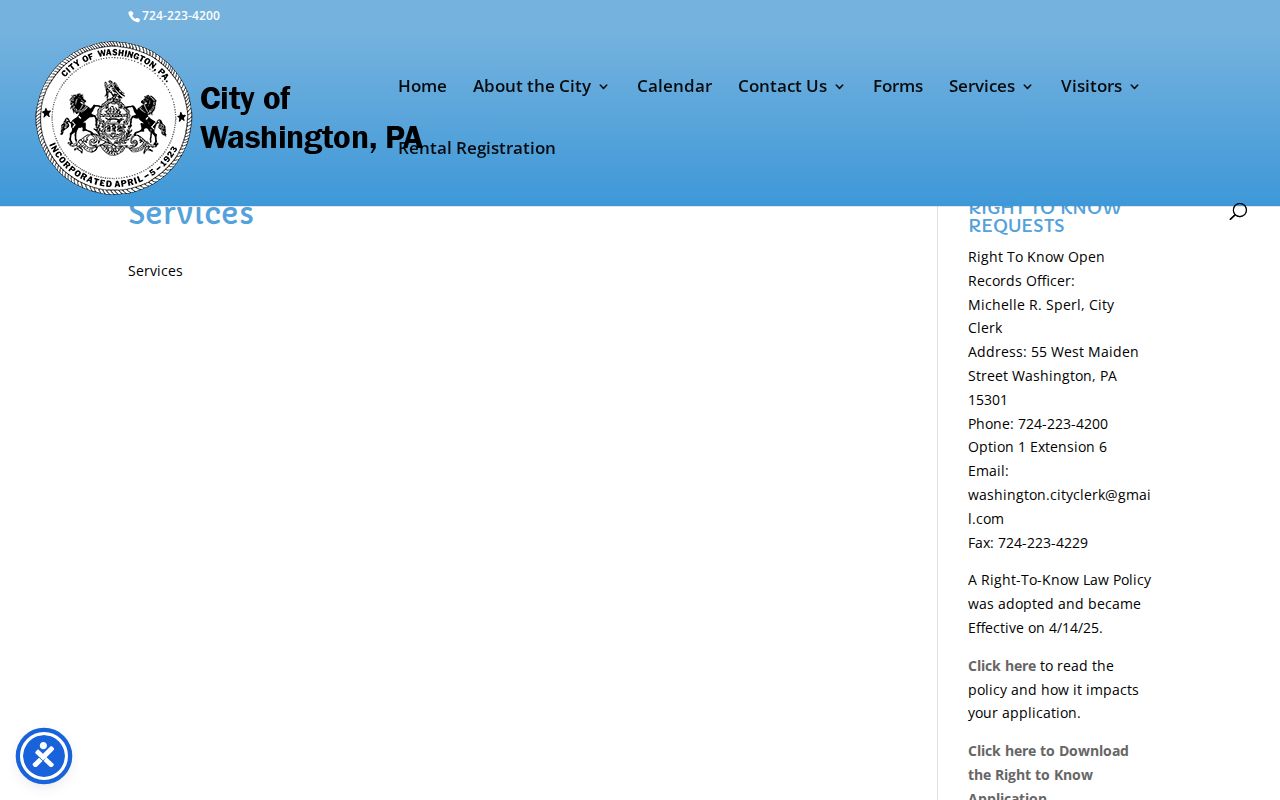
The city route can help place an administrative record beside a directory year, but it does not turn a historical listing into a current occupancy finding. Formal Right-to-Know requests must be in writing to preserve RTKL remedies. The city form offers submission by email, mail, fax, or in person, and choices for copies, inspection, or certified copies; it lists $0.50 per page and $15 for a police report. Access and redaction rules still apply.
Property within the City of Washington still uses county systems. Use the county Parcel & GIS Viewer for a mapped parcel and PIN, Tax Revenue for the assessment and property-record route, and the Recorder for deeds. The city does not replace the county's land-record custody with a separate city deed office.
Reading a Washington City Directory
No individual scanned entry was publicly available in the research material, so an exact sample should not be invented. Instead, inspect the chosen edition as a record in its own right. Publishers and layouts can vary across the long run. A name, abbreviated notation, address, or descriptor must be transcribed exactly from the page, with the edition year and page or column recorded beside it.
| Title and date | Record the exact directory title, publisher, and edition year before drawing a conclusion. |
|---|---|
| Name form | Capture spelling, initials, and any spouse or widow notation only if it appears in that entry. |
| Other descriptor | Preserve any occupation, business, residence marker, or other printed descriptor without expanding abbreviations by guesswork. |
| Address | Copy the house number and street as printed; historic formatting may differ from a modern address. |
| Page evidence | Keep the page or column and a copy of the abbreviation key for later checking. |
- Criss-cross section
- A street-ordered section that can organize listings by address. Ask library staff whether the selected volume has one; it is not promised for every year.
- Householder index
- An index arranged around household or address information, when the edition supplies one. It is not a universal feature of the documented collection.
- Abbreviation key
- The publisher's own explanation of shortened terms and symbols. Photograph or copy it before interpreting an entry.
Washington Directories and Newspapers
A directory places an adult or business marker in a particular edition. Newspapers can add a dated event, notice, obituary, or locality reference between editions. Citizens Library lists the Washington Reporter from August 1808 through April 1967, the Washington Observer from January 1872 through December 1969, and the Observer-Reporter from January 1970 through February 2018. It also lists the Claysville Recorder, 1894-1973, and McDonald Record Outlook, 1892-1983.
Keep the two sources separate in the research notes. A directory can establish that a name appeared in that published list. A newspaper item can describe an event or notice on its publication date. Neither source alone proves a full household, a legal ownership interest, or later presence at the same address. Library surname files, pedigree charts, county histories, biographies, and some family histories available through interlibrary loan can provide additional context when the question is genealogical.
Washington Directory and 1891 Maps
The November 1891 Washington Sanborn collection is a useful comparison layer because it has eight sheets and shows a dated built environment. It can help establish a street name, block setting, building footprint, or construction/use shorthand near the time of an older listing. It is not a resident roll and it is limited to the City of Washington, not all of Washington County. A rural township or outlying borough address needs land descriptions, municipal context, and other local collections instead.
Washington County's marriage-license information illustrates another separate record route that can be relevant to family-history timing.
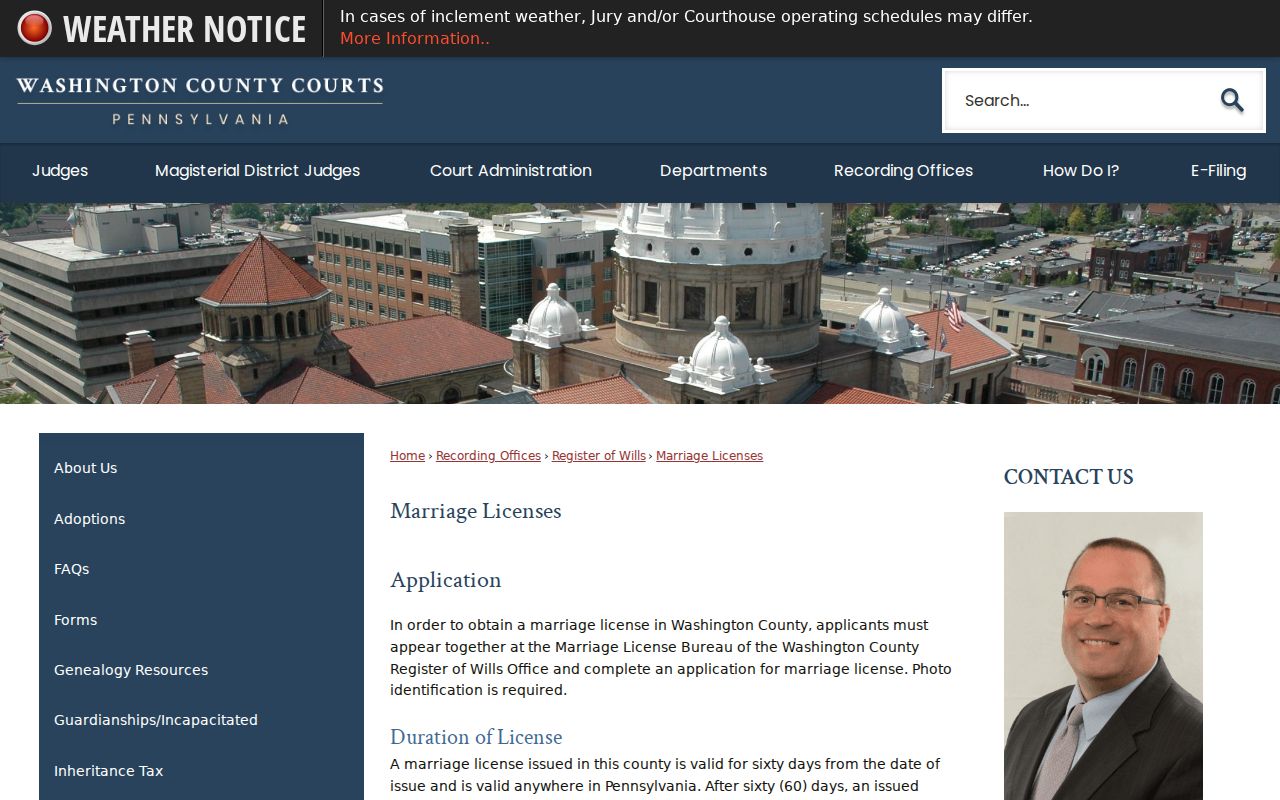
Marriage records are maintained through the county Register of Wills and are not an extension of the city directory collection. Matching a marriage date to a directory edition may sharpen a research question, but each record retains its own custodian, date, and access rules.
Trace Washington City Directory Households
A careful household trail compares nearby editions instead of treating one printed line as a biography. Start with the known spelling or address, then make each change visible in a timeline. The Pennsylvania State Archives reports federal census schedules from 1790 through 1930, except for the destroyed 1890 census. Census and directory dates therefore overlap imperfectly, which is useful for confirmation but leaves real gaps.
- Select the directory edition nearest the target year and record its complete citation before taking notes from an entry.
- Check the earlier and later available editions for a spelling change, new address, widow notation, or missing listing.
- Ask whether the exact volume has a street, reverse, or criss-cross section, then preserve any result as a separate listing type.
- Pair the edition with the nearest released federal census, marking one source as a printed adult listing and the other as a census household.
- Use a deed, assessment record, or dated newspaper item only for the question it answers, and retain the source date with it.
A disappearance from a directory has several possible explanations: a move, a death, a changed spelling, a coverage gap, or an editorial decision. It is a prompt for another dated source, not a final conclusion. For a current parcel or ownership question, use the county's modern address records rather than extending an old directory forward.
Washington Directory and College Records
Washington & Jefferson College's digital collection offers a bounded institutional source: its Biographical and Historical Catalogue covers 1802-1945 and includes people connected to Jefferson College, Washington College, and W&J. Geographical and alphabetical indexes can help with a college affiliation, classmate, faculty, staff, or historical notice question. The catalogue is not a countywide resident list and should not be used as one.
This narrow scope is valuable. It permits an affiliation finding tied to a date and institution without implying that a person lived in Washington at every point in the catalogue's coverage. Where a catalogue entry and directory listing point to the same person, retain both citations and describe each as its own kind of evidence.
Washington Directory Evidence by Date
Washington County formed from Westmoreland County on March 28, 1781. Earlier events may require predecessor-jurisdiction research before a Washington County record is expected. The surviving local trail is uneven: county deeds are reported remotely from 1781 to the present through Landex, the Sanborn view is from one month in 1891, the library directories begin in 1899 with gaps, and the 1890 federal census was destroyed. Date labels prevent these sources from being blended into a false continuous history.
The Washington County Historical Society's Norma K. Grimes Research Library is another fallback for hard cases. It is at 48 East Maiden Street, by appointment Tuesday through Friday from 11 a.m. to 4 p.m. Its published collections include deeds, wills, Orphans' Court material, family files, and contextual local material. Published research rates and turnaround details should be checked with the society before a request because services can change.
Note: Preserve the edition year, page reference, and uncertainty about spelling with every historical listing.